

5 Reasons They’re a Perfect Place to Start
Resistance bands are perfect for beginners!
Especially if you’re new to strength training, coming back after a long break, living with chronic pain, navigating perimenopause, or you’ve just never felt like traditional fitness spaces were made for you.
If dumbbells feel intimidating, gyms feel overwhelming, or past workout programs left you sore, frustrated, or discouraged, resistance bands offer a much more approachable way to build strength.
In this post, I’ll walk you through five reasons resistance bands are good for beginners, explain the two most common types of bands, and show you how to experience a beginner-friendly band workout in a way that feels supportive — not punishing.
Why Resistance Bands Are Good for Beginners
1. Resistance Bands Are Versatile (You Can Train Your Whole Body)
One of the biggest misconceptions about resistance bands is that they’re “just for rehab” or warm-ups. In reality, they’re incredibly versatile.
With resistance bands, you can train:
- Legs and glutes (squats, deadlifts, bridges)
- Upper body (rows, presses, arm work)
- Core (anti-rotation, controlled holds)
That means beginners can get a full-body strength training workout without needing multiple pieces of equipment. You’re not limited to one or two movements — and you’re not stuck doing “just cardio” if strength feels out of reach.
2. You Can Use Resistance Bands at Home (and Store Them in a Drawer)
Resistance bands are ideal for at-home workouts for beginners.
There’s no commute.
No gym intimidation.
No equipment setup that eats up half your energy.
They’re lightweight, portable, and compact enough to:
- Live in a drawer
- Travel with you
- Be pulled out for a 20-minute workout without turning it into a whole production
For many beginners, removing those barriers is what makes consistency possible in the first place.
3. Resistance Bands Are Affordable
Starting something new can feel risky — especially if you’ve tried other programs that didn’t stick.
Resistance bands are a low-cost, high-value option:
- One set can replace multiple weights
- You don’t need to “upgrade” right away
- You can build real strength without a big financial commitment
For under $30, you can get yourself two sets of bands, which is all you need for a full body strength training workout.That affordability makes them a great entry point for beginners who want to experiment, learn, and build confidence without pressure.
4. Resistance Bands Are Low Impact and Joint-Friendly
This is one of the biggest reasons I recommend resistance bands for beginners.
Bands provide smooth, controlled resistance, which means:
- Less joint compression
- More control over range of motion
- Easier adjustments on low-energy or high-pain days
For people living with chronic pain, joint sensitivity, or bodies that don’t respond well to high-impact workouts, resistance bands allow you to build strength without beating yourself up.
Low impact doesn’t mean low benefit — it means sustainable.
5. Resistance Bands Let You Choose (and Progress) Your Resistance
With resistance bands, you’re in charge of how hard things feel.
You can:
- Choose lighter or heavier bands
- Adjust tension by changing your stance
- Progress gradually as your strength improves
This built-in progression is especially helpful for beginners who don’t want to jump too far, too fast. Strength builds over time — and bands let that process unfold without pressure to “keep up.”
The Two Most Popular Types of Resistance Bands (and What They’re Best For)
Loop Bands
Loop bands are continuous circles of elastic.
They’re great for:
- Lower body exercises (glutes, hips, legs)
- Squats, bridges, and lateral walks
- Beginners who want simple setup and clear feedback
They’re commonly used in physical therapy and beginner programs because they’re easy to control and very joint-friendly.

Long Resistance Bands
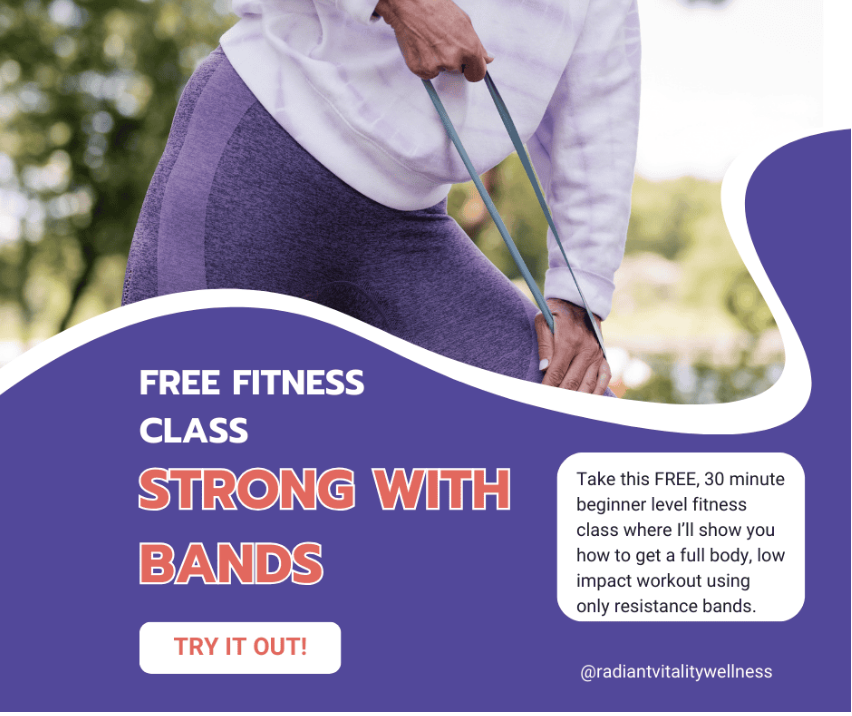
Long resistance bands (with or without handles) are ideal for full-body strength training.
They’re especially useful for:
- Rows, presses, and chest exercises
- Mimicking dumbbell-style movements
- Upper body strength for beginners
These two types are the bands I often use when teaching beginners how to build strength in a way that transfers to everyday life.

Final Thoughts: Are Resistance Bands Good for Beginners?
Resistance bands are an excellent starting point for beginners because they’re versatile, affordable, low impact, and adaptable to your body and your needs.
They allow you to build strength gradually, safely, and confidently — without needing a gym membership or a “no pain, no gain” mindset.

Radiant Vitality – Kim Hagle
Body Positive Personal Trainer for Women Over 40. Located in Goderich, ON and serving clients online throughout North America
Check Out Our Latest Posts
-

Body Positive Fitness: A Guide for Women Who’ve Been Burned by Fitness Culture
Body positivity in fitness isn’t a trend, a marketing buzzword, or a softer way of selling you the same old fitness culture nonsense. It’s a completely different way of thinking about movement — one where your body doesn’t have to earn the right to exist in a gym, in workout clothes, or in a class…
-

I’m Scared to Go to the Gym Because of My Size
If you’ve ever typed “I’m scared to go to the gym because of my size” into a search bar at midnight, this post is for you. I’m not going to tell you to push past your fear or give you a pep talk about confidence. I’m going to tell you something the fitness industry has…
-

How to Be Consistent with Exercise (Without Burning Out or Starting Over)
If you’ve been trying to figure out how to be consistent with exercise, and feeling like you’re the only one who can’t seem to make it work, this is for you. Not because you need more motivation or a stricter plan. But because after 15 years as a personal trainer, I can tell you with…



0 Comments