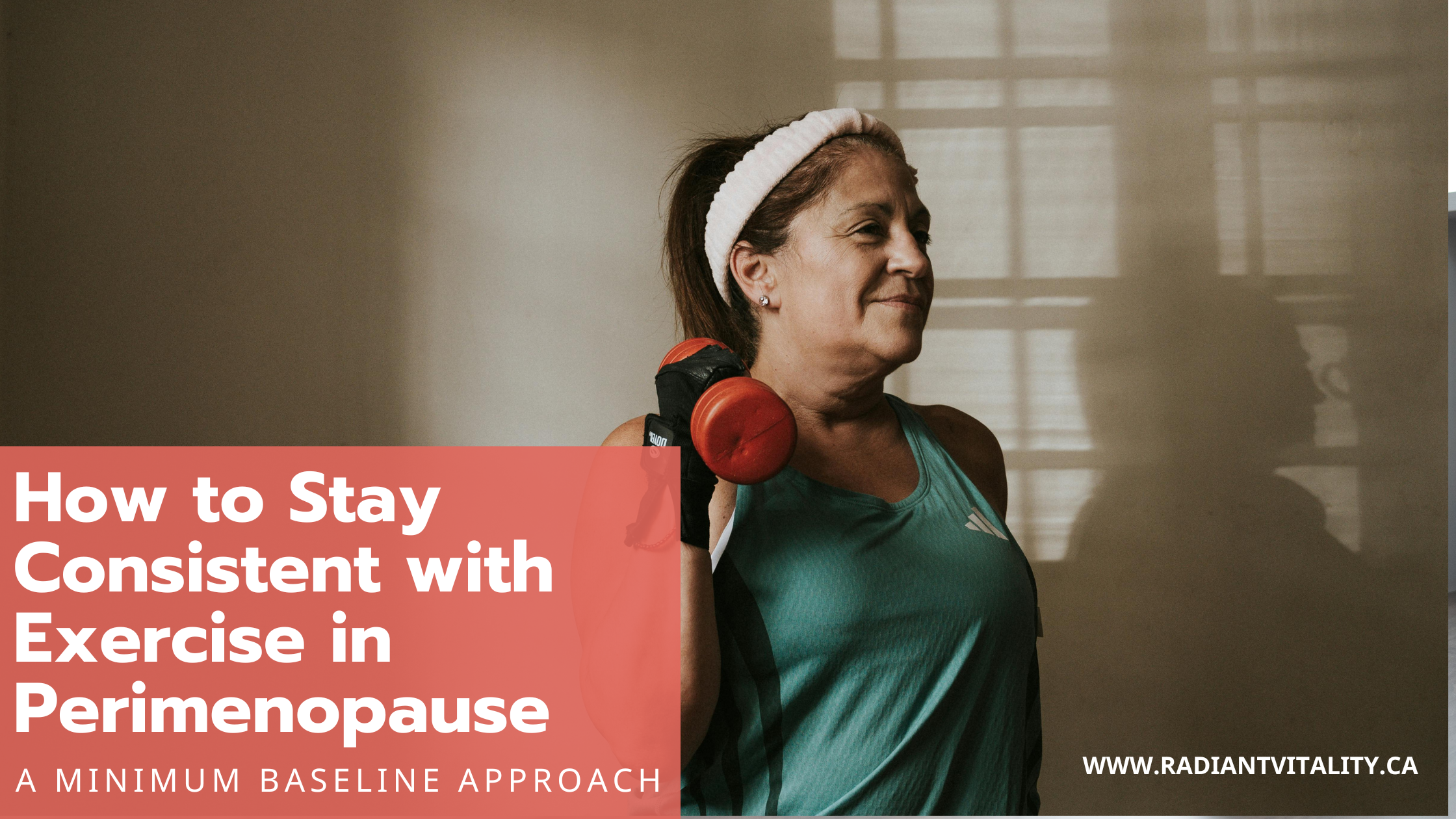
How to Stay Consistent with Exercise in Perimenopause (A Minimum Baseline Approach)

by | May 14, 2026

Have you ever noticed how good it feels to win?

Not in a big, flashy, life-changing way—but in a quiet, everyday kind of way.

You check something off your list.
You follow through on something you said you’d do.
You keep a promise to yourself.

It feels really good.

Now let me ask you this…

Why is it that when it comes to fitness, so many of us set ourselves up to lose?


The Fitness Trap So Many Women Fall Into

Somewhere along the way, we were taught that “consistency” in fitness looks like:

  • 1 hour workouts
  • 5 days a week
  • Pushing hard every time
  • Sweaty, exhausted, all-out effort

And if you’re not doing that?

You’re not trying hard enough.
You’re not committed enough.
You’re not doing it “right.”

That messaging is everywhere—and it’s convincing.

But here’s the problem:

That version of consistency doesn’t fit into real life for most women.
And it’s especially unrealistic during perimenopause.


Why Exercise Feels Harder to Stick With in Perimenopause

If you’ve ever thought…

“Why can’t I stay consistent like I used to?”
“Why does everything feel harder now?”

You’re not imagining it—and you’re definitely not failing.

Perimenopause brings real, physiological changes that directly impact your ability to stick with a traditional fitness routine.

Things like:

  • Fluctuating hormones that affect energy, mood, and motivation
  • Increased sensitivity to stress, making intense workouts harder to recover from
  • Sleep disruptions, which reduce energy and increase fatigue
  • Joint pain or stiffness, especially if you’re already dealing with old injuries or chronic conditions
  • Longer recovery times, meaning you can’t just “push through” like you may have in your 20s or 30s

These changes aren’t just in your head—they’re well documented. Cleveland Clinic outlines how hormonal shifts during perimenopause can affect sleep, energy, and overall physical resilience, all of which play a role in how consistent you’re able to be with exercise:
👉 https://my.clevelandclinic.org/health/diseases/21608-perimenopause

On top of that, you’re likely navigating a full life—work, family, responsibilities, maybe even caring for others.

That “1 hour, 5 days a week, go hard every time” model?

It doesn’t account for any of this.

And when your plan doesn’t match your reality, it’s not a motivation problem…

👉 It’s a strategy problem.


What If You Created a Game You Could Win?

This is something I say to my clients all the time:

Create a game you can win.

Because when you win?

You feel good.
And when you feel good, you’re more likely to keep going.

This is where the idea of a minimum baseline comes in.


What Is a Minimum Baseline?

Your minimum baseline is the lowest level of effort that still counts as a win.

Not your best day.
Not your ideal routine.
Not what you used to be able to do.

But what you can realistically do on a regular basis, with the time, energy, and capacity you actually have right now.

It should feel almost… too easy.

Like:

  • “I can definitely do that.”
  • “Even on a busy day, I could manage this.”
  • “Even if I’m tired, I could still follow through.”

That’s the point.

Because consistency isn’t built on your best days.
It’s built on your most average ones.


Let’s Look at the Math (And What It Really Means)

Let’s compare two approaches.

Approach A: The “All In” Plan

  • 1 hour per workout
  • 5 days per week
  • Total: 5 hours/week

Let’s say you keep that up for 2 months before life gets busy or your body pushes back:

👉 5 hours × 8 weeks = 40 hours total


Approach B: The Minimum Baseline

  • 20 minutes per workout
  • 3 days per week
  • Total: 1 hour/week

And this time, you stick with it for a full year:

👉 1 hour × 52 weeks = 52 hours total


At first glance, those numbers might not look wildly different.

But here’s what is different:

Approach A (All In) often leads to:

  • Burnout (mental and physical)
  • Increased risk of injury
  • Flare-ups of chronic pain
  • Elevated cortisol levels from constant high intensity
  • Poor recovery and lingering fatigue
  • Disrupted sleep
  • The all-or-nothing cycle (“I fell off, so why bother?”)

Which usually results in… stopping altogether.


Approach B (Minimum Baseline) creates:

  • Steady, repeatable movement week after week
  • Better recovery between sessions
  • Lower overall stress on your system
  • More stable energy levels
  • Increased confidence and motivation
  • Habits that actually stick

And most importantly:

👉 You stay in the game long enough to see real results.


So the question isn’t just:

“How many hours are you putting in?”

It’s:

“How long can you keep going?”

Because fitness results don’t come from what you do for 8 intense weeks.

They come from what you can sustain for months—and years.


Why Minimum Baseline Works

When your goal is achievable, a few important things happen:

  • You follow through more often
  • You build trust with yourself
  • You reduce the all-or-nothing cycle
  • You create momentum
  • You stay consistent long enough to actually see results

And here’s the kicker:

You can always do more on the days you have the capacity.

But your baseline is your safety net—the thing that keeps you in the game when life gets hard.

Research supports this, too. Chronic stress—whether from life or consistently pushing your body too hard in workouts—can keep cortisol elevated, which impacts energy, sleep, and recovery over time. Harvard Health Publishing explains this really clearly in their article on the stress response:

👉 https://www.health.harvard.edu/staying-healthy/understanding-the-stress-response


This Isn’t About Doing the Bare Minimum

Let’s be clear—this isn’t about settling.

It’s about being strategic.

It’s about recognizing that the most effective plan isn’t the one that looks the most intense…

It’s the one you can actually stick with.


Tips: How to Set Your Own Minimum Baseline

If you want to try this approach, here’s how to start:

1. Be honest about your real life

Not your ideal schedule—your actual one.

How much time and energy do you realistically have most days?

2. Lower the bar (yes, really)

If your plan feels a little too easy… you’re probably doing it right.

Think:

  • 15–20 minutes
  • 2–3 times per week

3. Define what counts as a “win”

Be specific.

Instead of “work out more,” try:

  • “Complete 2 strength workouts this week”
  • “Move my body for 15 minutes”

4. Keep it flexible

Your baseline is your minimum, not your limit.

If you feel good, you can always do more.
But you don’t have to.

5. Track your wins

This matters more than you think.

Every time you meet your baseline, you reinforce:
👉 “I’m someone who follows through.”

6. Give it time

The magic isn’t in one week.

It’s in what happens when you keep going for months.

The Bottom Line

You don’t need to work harder.

You need a plan that works with your life—not against it.

Because the real goal isn’t to have a perfect week…

It’s to build something you can keep coming back to.

Again and again.

You Don’t Have to Figure This Out Alone

If you’re reading this and thinking, “This is exactly what I need—but I don’t know how to put it into practice…”

You’re not alone.

Knowing what makes sense is one thing.
Actually building a routine that fits your body, your energy, and your life? That’s a whole different layer.

That’s exactly the kind of support I offer.

Inside my coaching and programs, we focus on helping you:

  • Build strength in a way that feels doable (not overwhelming)
  • Work with your body instead of pushing against it
  • Create a minimum baseline that actually fits your real life
  • Stay consistent without burning out or starting over (again)

Because you deserve a version of fitness that feels supportive—not stressful.

If that sounds like what you’ve been missing, I’d love to help.
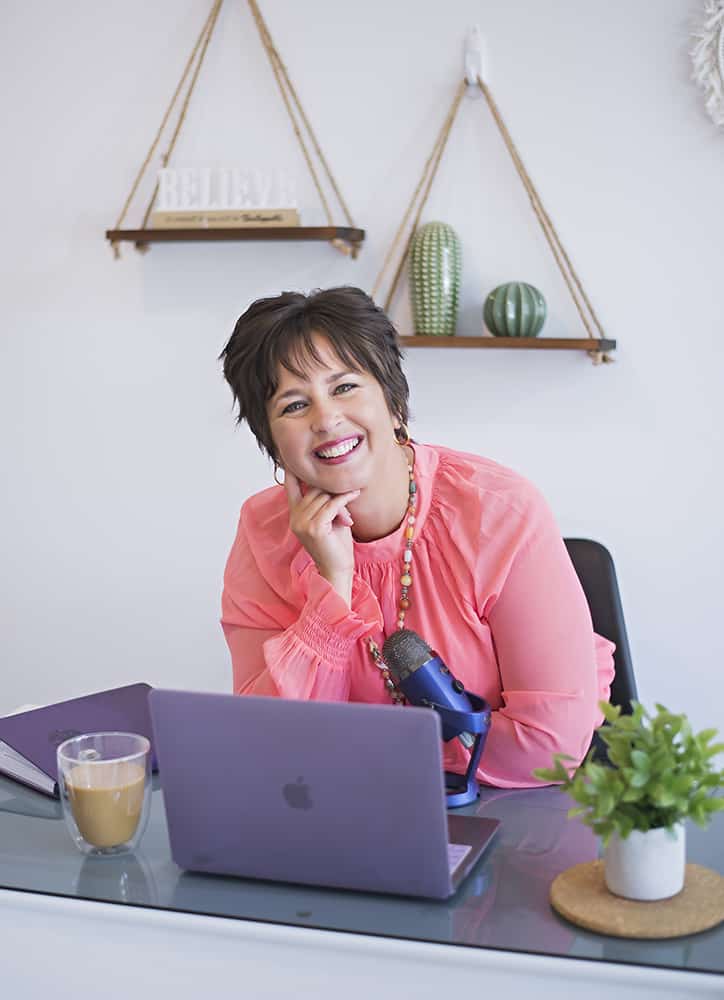
Kim Hagle - Body Image Coach - Size Inclusive Fitness Specialist - Non Diet Nutritionist

Radiant Vitality – Kim Hagle

Body Positive Personal Trainer for Women Over 40. Located in Goderich, ON and serving clients online throughout North America

Check Out Our Latest Posts

  • How To Find The Motivation To Workout: 7 Ways To Finally Stay Consistent With Exercise

    How To Find The Motivation To Workout: 7 Ways To Finally Stay Consistent With Exercise

    If you’ve been trying to figure out how to find the motivation to workout, you’re not alone; and you’re not broken. In my 15 years as a body-positive personal trainer, lack of motivation is the single most common reason people struggle to start or stay consistent with exercise. But here’s what most fitness advice gets…

  • Is Strength Training Safe If You Have Chronic Pain?

    Is Strength Training Safe If You Have Chronic Pain?

    Wondering if strength training with chronic pain is actually safe? The short answer is yes — when it’s approached in a way that works with your body instead of against it. In this article, you’ll learn how to start strength training safely when living with chronic pain, fibromyalgia, fatigue, or mobility limitations. We’ll cover beginner-friendly…

  • How to Stay Consistent with Exercise in Perimenopause (A Minimum Baseline Approach)

    How to Stay Consistent with Exercise in Perimenopause (A Minimum Baseline Approach)

    If you’re struggling to stay consistent with exercise in perimenopause, this post introduces a more sustainable approach. Learn how setting a realistic minimum baseline can help you avoid burnout, support your hormones, and build long-term strength and consistency—without all-or-nothing pressure.
Hey Gorgeous, I'm Kim (she/her)

I’m a body positive personal trainer for women over 40 who feel like “fitness misfits”.

It’s my mission to make the life changing benefits of movement available to ALL bodies, especially those who feel like they don’t “fit” in fitness spaces.

Kim Hagle - Body Positive Personal Trainer for Women over 40

Thanks for Visiting the Radiant Vitality Blog

Kim Hagle  is a body positive personal trainer, body image coach and founder of Radiant Vitality Wellness.

She offers customized personal training, in person group fitness classes, online fitness programs and body image coaching services  in Goderich, ON  and virtually across North America.

Kim holds a BScN and is an ACE certified personal trainer.  She is also a size inclusive fitness specialist, and a certified health and life coach specializing in Body Image.  You can read more about Kim here.

Follow Radiant Vitality on Social

0 Comments

Check Out Our Recent Posts

How To Find The Motivation To Workout: 7 Ways To Finally Stay Consistent With Exercise

If you’ve been trying to figure out how to find the motivation to workout, you’re not alone; and you’re not broken. In my 15 years as a body-positive personal trainer, lack of motivation is the single most common reason people struggle to start or stay consistent with exercise.

But here’s what most fitness advice gets wrong: the strategies typically used to improve exercise motivation (accountability challenges, strict programs, “no excuses” mantras) often make the problem worse.

The real issue isn’t that you don’t know how to motivate yourself to work out. It’s that the fitness industry has been pointing you in the wrong direction entirely.

In this post, I’m sharing 7 evidence-backed, body-positive strategies to help you:

Overcome lack of motivation to exercise once and for all

Build a movement habit that fits your real life

Shift from dreading workouts to actually wanting to move.

Is Strength Training Safe If You Have Chronic Pain? 6 Ways to Start Strength Training Safely When You Live with Chronic Pain

Is Strength Training Safe If You Have Chronic Pain?

Wondering if strength training with chronic pain is actually safe? The short answer is yes — when it’s approached in a way that works with your body instead of against it.
In this article, you’ll learn how to start strength training safely when living with chronic pain, fibromyalgia, fatigue, or mobility limitations. We’ll cover beginner-friendly strategies like low impact strength training, pacing, using modifications, and learning the difference between productive discomfort and pain that signals your body needs something different.
You’ll also discover why tracking workouts and symptoms can help you identify your personal “sweet spot” with movement, making it easier to exercise consistently without triggering unnecessary flare-ups.
This post is designed for fitness misfits who feel intimidated, excluded, or discouraged by traditional fitness culture and want a more compassionate, sustainable approach to exercise.
Whether you’re brand new to movement or trying to rebuild trust with your body after years of pain, this guide will help you approach strength training with more confidence, flexibility, and self-compassion — without the “no pain, no gain” mindset.

Do You Need To Get In Shape Before Hiring a Personal Trainer - 5 Honest Answers

Do You Need to Get in Shape Before Hiring a Personal Trainer?

Thinking about hiring a personal trainer but feel like you need to get in shape first? You’re not alone. In this post, we break down five key points to help you understand what personal training really is —and who it’s actually for. (Hint: it’s not just athletes or already-fit people.) You’ll learn why starting with support can make things easier, safer, and more sustainable, especially if you’re feeling out of shape or unsure where to begin. If hiring a personal trainer has been on your mind, this guide will help you take that first step with confidence.

5 Ways to Start Strength Training When You Feel Completely Out of Shape

5 Ways to Start Strength Training When You Feel Completely Out of Shape

In 5 Ways to Start Strength Training When You Feel Completely Out of Shape, you’ll learn how to begin in a way that actually feels doable. If you’re feeling overwhelmed, out of shape, or unsure where to start, this guide breaks it down into five simple, realistic steps. From starting smaller than you think to choosing movements that feel safe and supportive, you’ll build strength, confidence, and consistency without pressure or perfection. This beginner-friendly approach is especially helpful if you’re returning after a long break or managing pain, helping you create a sustainable strength training routine that fits your life.

a photo of bands and dumbbells with on screen text "Resistance bands vs weights for beginners - Which is a better place to start?"

Resistance Bands vs Weights for Beginners: Which Is Better to Start With?

If you’re new to strength training, it’s common to wonder whether you should be using resistance bands or weights. Both can help you build strength — but they don’t feel the same, especially for beginners. This post compares resistance bands vs weights for beginners, looking at joint impact, ease of use, cost, and confidence. You’ll learn the pros and cons of each option and why resistance bands are often a more supportive place to start, particularly if you want low-impact, beginner-friendly strength training you can do at home without pressure or intimidation.

A person working out with a long resistance band with support from a trainer. Text box reads "Are resistance bands good for beginners. 5 reasons why they're the perfect place to start"

Are Resistance Bands Good for Beginners? 

Resistance bands are an excellent choice for beginners who want to build strength without intimidation or high-impact workouts. They’re versatile enough for full-body strength training, affordable, and easy to use at home with minimal space. Resistance bands are also joint-friendly, making them a great option for people with chronic pain, mobility limitations, or those returning to exercise after a break. With multiple resistance levels, they allow beginners to progress at their own pace. This post explains five reasons resistance bands are good for beginners, outlines the most common types of bands, and shares how to try a beginner-friendly band workout.

Small Fitness Wins: How Tiny Steps Build Lasting Strength

Small Fitness Wins for Women Over 40: How Tiny Steps Build Lasting Strength

Lasting fitness success isn’t built through dramatic transformations or all-or-nothing effort—it’s built through small, consistent actions over time. For women over 40, especially those navigating busy lives, chronic pain, or years of frustrating fitness experiences, focusing on small fitness wins can be the key to building habits that actually stick.
This article explores how small wins—like adding one extra set, moving for five more minutes, or choosing rest when your body needs it—create meaningful progress without burnout. Instead of relying on the scale, it highlights powerful non-scale victories such as improved energy, better sleep, stronger joints, and increased confidence. These changes often show up long before visible results, yet they’re the foundation of sustainable strength and mobility.
You’ll also learn practical ways to track progress that support motivation rather than shame, and how shifting away from perfectionism can transform your relationship with movement. By celebrating what your body can do today, you build momentum that carries you forward—one small, achievable step at a time.

The Best Way to Work Out with Chronic Pain (without making it worse)

The Best Way to Work Out With Chronic Pain (Without Making It Worse)

Discover a balanced, evidence-informed way to exercise with chronic pain. This guide breaks down why movement helps, how to structure your week, and how to stay consistent without making pain worse.

Strength Training for Beginners Over 40: How to Start Without Hurting Yourself

Strength Training for Beginners Over 40: How to Start Without Hurting Yourself

Strength training after 40 can feel intimidating — especially if you’re worried about injury. This beginner-friendly guide explains how to start safely, build strength gradually, and support your body instead of pushing it too hard.

How to Set Fitness Goals After 40 (that actually stick without "no pain, no gain")

How to Set Fitness Goals After 40 (That Actually Stick Without “No Pain, No Gain”)

Learning how to set fitness goals after 40 requires a different approach—one that respects your body, your energy, and your real life. In this post, you’ll learn how to create fitness goals that actually stick, without shame, extremes, or punishing workouts. We’ll explore a smarter, self-aligned way to build consistency, motivation, and strength—especially if traditional fitness culture has never felt like it was made for you.