

If you’ve ever started a New Year feeling fired up about your fitness goals—only to feel defeated, behind, or guilty a few weeks later—you are absolutely not alone.
Maybe you said:
- “This is the year I’ll finally be consistent.”
- “This time I’ll actually stick with it.”
- “If I can just lose the weight, everything will feel easier.”
But… then life happened.
Your knees flared up.
Your energy dipped.
Work got busy.
Motivation disappeared.
By February, it felt like you “failed” again.
Here’s the truth I wish more women were told:
Most goals don’t fail because of willpower. They fail because of how we’re taught to set them.
And after 40—when your hormones, nervous system, energy, and responsibilities change—that old system breaks down even faster.
Let’s talk about why… and what actually works instead.
The Stats On Goal Setting
About 7 out of 10 adults in the U.S. set goals at the beginning of the year.
Of those people, 71% believe they’re very or somewhat likely to stick to them.
The most common goals?
- Improving health
- Improving finances
Followed by:
- Personal development
- Career
- Relationships
- Spiritual growth
(Source: YouGov + Statista data on New Year’s resolutions)
But here’s where things really fall apart:
- Only about 1/3 of goal-setters actually make a concrete plan
- 55% of people set the same goal each year
- And depending on the source, up to 80–90% of New Year’s resolutions are not achieved
You can explore these patterns here:
- University of Scranton research cited by U.S. News:
https://health.usnews.com/health-news/articles/why-new-years-resolutions-fail - American Psychological Association on why resolutions fail:
https://www.apa.org/monitor/dec01/resolutions - UCLA Health on long-term behavior change and dieting failure:
https://www.uclahealth.org/news/dieting-does-not-work-ucla-researchers-report
The research varies, and not all of it is perfectly controlled—but even with that in mind, one thing is painfully clear:
For most people, especially with New Year’s resolutions, achieving goals is genuinely hard—and the “failure” rate is high.
And you don’t need a study to confirm that.
You’ve probably lived it.
The Problem Isn’t You—It’s the System
Most of us were taught to set goals using the SMART framework:
- Specific
- Measurable
- Action-Oriented / Attainable
- Realistic
- Timely
And listen—SMART goals are not bad.
They absolutely help with clarity. They force you to get specific.
Instead of:
“I want to save money.”
You’re pushed to say:
“I want to save $3,000 by December.”
That part is helpful.
But the problem is this:
Even when goals are SMART… people still burn out, quit, or feel like failures.
So the SMART system can’t be the full answer.
The Deeper Issue With Traditional Goal Setting
Most traditional goals—especially fitness and body goals—are rooted in:
- A desire to fix something about ourselves
- The belief that we’ll be happier once we reach the goal
- A success/failure mindset where our worth is measured by results
We ignore the journey.
We ignore the learning.
We ignore the growth.
We just want the outcome.
Why Achieving Your Goals Isn’t Enough: A Personal Example
Years ago, I set a big, impressive fitness goal:
Training for and running a full marathon.
It was SMART. It was measurable. It had a clear timeline.
But my “WHY” – that’s where things went wrong. As someone who was the last kid picked for all the sports teams growing up, I had something to prove… to myself and everyone who bullied me in school.
I chose to run that marathon because it seemed like “the thing” that would make me feel better about myself and my abilities. I truly believed:
“When I finish this, I’ll finally feel proud of myself. I’ll finally feel like a ‘real athlete.’”
I trained hard. I got injured but I pushed through. I showed up – no excuses.
I finished the marathon… but I got hurt doing it.
And instead of confidence… I felt disappointment.
Instead of pride… I felt like I should have done better.
Instead of worthiness… I criticized myself for my time, my pace, my performance.
The goal didn’t give me the feeling of accomplishment I thought it would.
Because the feeling was never coming from the finish line.
It was coming from the belief I carried about myself. In this case the belief was “I’m not a real athlete”.
The Emotional Pattern Behind Most Goals
Like most goal setters, my marathon goal was all about proving myself, using the goal to compensate for an insecurity, and making the wrong assumption that once I achieved it, I’d suddenly feel better about who I am.
When goals are rooted in self-fixing, this is usually what happens:
- You think you’ll feel better when you accomplish your goal
- You fantasize about how much easier life will be “after”
- You see achievement as the gateway to self-acceptance
- You give yourself a deadline
- You feel urgency and pressure
- The journey doesn’t matter—only the outcome
- You feel a dopamine “high” when making your grand plan
- If you hit a roadblock, you spiral and start over
- If you don’t hit the goal, you think you are the failure
- And if you do hit the goal, you can’t wait to prove it to everyone
This is why SMART goals often end up feeling not so smart. Rather they turn out to be:
- S – Shame-based
- M – Motivation-killing
- A – Arbitrary
- R – Too rigid
- T -Too restrictive
They look smart on paper…
But emotionally and psychologically?
They often work against us.
The Real Problem: Using Achievement as a Pathway to Self-Acceptance
Two big mistakes we make with traditional goals:
- We focus only on the outcome—not the growth
- We use goals as a way to earn self-worth
And that’s where things really fall apart.
Why “Fixing Yourself” Never Leads to Sustainable Change

This model (from Cognitive Behavioural Coaching) illustrates how our thoughts and beliefs shape the results we get in life.
Circumstances lead to Thoughts lead to Feelings lead to Actions lead to Results
Let’s use weight loss as an example.
If the circumstance is your size/weight
And your thought is:
“My body is (ugly, unhealthy, out of shape… whatever negative association you attribute to your weight) .”
Your feelings often become:
- Shame
- Urgency
- Inadequacy
- Self-doubt
Those feelings lead to actions such as food rules and exercise that feel:
- Punishing
- Extreme
- Unsustainable
Which leads to results like:
- Injury
- Burnout
- Quitting
- Regain
- Restarting
And that reinforces the original belief:
“See? I’m the problem.”
This cycle isn’t a motivation problem.
It’s a belief problem.
There Is a Better Way
Aligned Goals: How to Set Goals that Stick
Aligned goals are built on a completely different foundation.
Aligned goals start with this belief:
You are already enough. You don’t need fixing.
Instead of:
- “I’ll be worthy when I achieve this…”
Aligned goals say:
- “I’m worthy now. I love and accept myself as is—and I want to improve my quality of life.”
What Makes Aligned Goals Different?
- Success is defined by who you’re becoming—not just what you do
- You can’t fail—because the goal is growth and learning
- There are no rigid deadlines
- Challenges are expected and supported
- You’re allowed to change your mind if it’s no longer aligned
This removes shame.
This removes urgency.
This removes the fear of failure.
And that’s what makes motivation sustainable.
Aligned Goals in Real Life – My Hair Growth Story
For years, I loved my short haircut.
But eventually, I got bored and felt limited by what I could do with it. I started thinking about growing it out.
This wasn’t a new thought. I’d tried growing my hair out before, but every time I tried, I quit during the awkward stages and chopped it all off again. I couldn’t bear the discomfort of having “bad hair” for weeks on end and it felt easier to go back to what was familiar.
Two and a half years ago, I tried again—but this time, something was different.
Here’s what changed:
- My WHY was entirely different – I was growing my hair because I wanted to have more styling options, NOT because I thought that long hair was better or would make me better in some way.
- I let it take as long as it would take (no deadline)
- I got comfortable being uncomfortable – I accepted that awkwardness was going to be part of the process
- I experimented with new styling strategies – and accepted that some would work and some wouldn’t
- I gave myself permission to quit anytime – and either cut it off again, or stop growing…. And neither decision meant anything about me.
And every time I re-evaluated, I realized:
“I still want this.”
Now I have long hair and so many new styling options to play with.
But here’s the most important part:
Growing my hair didn’t make me feel better about myself, my appearance or my worth.
It just gave me more options for self-expression—because I already accepted myself.
That’s how aligned goals work.


How Motivation Actually Works
When it comes to motivation—whether it’s for exercise, career goals, or personal growth—research consistently shows that four major factors predict long-term follow-through. This comes from Self-Determination Theory, one of the most well-supported motivation frameworks in psychology.
According to this research, we stay motivated when:
- ✅ We enjoy the action
- ✅ We feel competent (or supported while learning)
- ✅ We have a sense of community and connection
- ✅ We can see how the action is meaningfully improving our lives
You can explore this research here if you’re curious:
- Self-Determination Theory overview (Verywell Health):
https://www.verywellmind.com/what-is-self-determination-theory-2795387 - The three psychological needs behind motivation (Psychology Today):
https://www.psychologytoday.com/ca/basics/motivation
This is exactly why shame-based, punishment-style fitness plans fail long-term:
They destroy enjoyment.
They erode confidence.
They isolate people.
And they disconnect action from meaningful reward.
As a fitness coach, I see this every single day:
People don’t quit because they’re lazy.
They quit because the process feels miserable.
If this part about motivation is really resonating with you, you might also love this deeper dive I wrote on why motivation feels so hard to access sometimes—and how to rebuild it without pressure or guilt:
👉 How to Improve Exercise Motivation (Even If You’ve Tried and Failed Before)
https://radiantvitality.ca/improve-exercise-motivation/
It pairs beautifully with this goal-setting work and will help you understand what your nervous system, habits, and beliefs have to do with follow-through.
Introducing SMARTER Goals (Aligned Goals That Actually Stick)
Instead of SMART goals, I teach SMARTER goals:
- S- Self-Aligned – rooted in who you are
- M- Meaningful – genuinely important to you
- A – Adaptive – flexible and open to learning
- R – Respectful – honors your capacity and season of life
- T – Timeless – not ruled by arbitrary deadlines
- E- Enjoyable – feels good to practice
- R – Reflective – encourages awareness and adjustment
This is how goals become sustainable instead of stressful.
How to Practice Setting an Aligned Goal
Choose one area to focus on:
- Health
- Personal Growth
- Work
- Relationships
Then ask:
- Why does this goal matter to me?
What will it add to my life emotionally? - What actions will I need to take?
And how do those actions feel in my body—excited or dreadful? - What thoughts about myself will support me when it gets hard?
A great example: “I’m already enough. I’m worth the effort”
If the goal feels heavy, urgent, or rooted in self-fixing—it just needs tweaking, not abandoning.
Don’t Wait to Be Proud of Yourself
You do not need to earn pride at the finish line.
You deserve to be proud of yourself every step of the way.
For showing up.
For learning.
For trying again.
For choosing growth over shame.
Goal Setting Workbook
To support you in your Aligned Goal Setting for 2026, I’ve created a lovely workbook to guide you through the process. Enter your email in the box below and I’ll send it right over to you!
Make 2026 The Year You Finally Achieve Your Fitness Goals
If 2026 Is the Year You’re Ready to Do This Differently…
If you’ve been reading this and thinking:
- “I don’t want another year of starting over.”
- “I don’t want to hate my body into change anymore.”
- “I want to get stronger—but without a side of shame or ‘no pain, no gain.’”
Then maybe 2026 is the year you finally choose a different approach.
One built on:
- Self-acceptance instead of self-criticism
- Strength without punishment
- Consistency without burnout
- Movement that actually feels safe, supportive, and sustainable
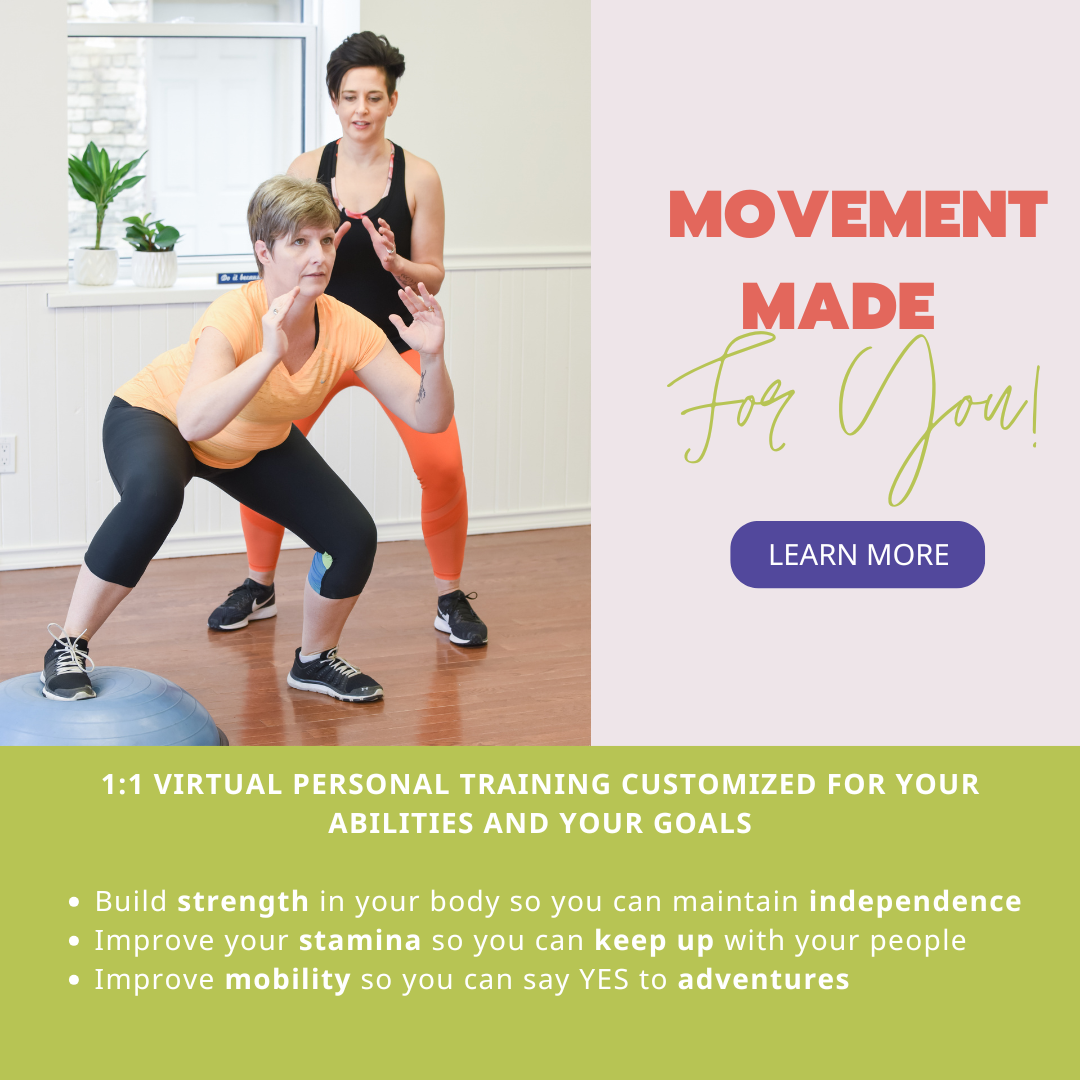
That’s exactly why I created Movement Made for You—my 1:1 personalized coaching program for women who:
- Feel like they don’t belong in traditional fitness spaces
- Live with chronic pain, injuries, fear of getting hurt, or past exercise trauma
- Are tired of being told to “just push through”
- Want to feel stronger, more capable, and more at home in their body
Inside Movement Made for You, we don’t chase punishment.
We build aligned, realistic, shame-free strength—at your pace, in your body, for your life.
If you’re ready to make 2026 the year you:
✔️ Stop starting over
✔️ Stop “fixing” yourself
✔️ And finally build a peaceful, sustainable relationship with movement
You can learn more and apply here:
👉 Movement Made for You – 1:1 Personalized Coaching
You don’t need to become someone else to take care of yourself.
You already deserve support—exactly as you are.


Radiant Vitality – Kim Hagle
Body Positive Personal Trainer for Women Over 40. Located in Goderich, ON and serving clients online throughout North America
Check Out Our Latest Posts
-

Body Positive Fitness: A Guide for Women Who’ve Been Burned by Fitness Culture
Body positivity in fitness isn’t a trend, a marketing buzzword, or a softer way of selling you the same old fitness culture nonsense. It’s a completely different way of thinking about movement — one where your body doesn’t have to earn the right to exist in a gym, in workout clothes, or in a class…
-

I’m Scared to Go to the Gym Because of My Size
If you’ve ever typed “I’m scared to go to the gym because of my size” into a search bar at midnight, this post is for you. I’m not going to tell you to push past your fear or give you a pep talk about confidence. I’m going to tell you something the fitness industry has…
-

How to Be Consistent with Exercise (Without Burning Out or Starting Over)
If you’ve been trying to figure out how to be consistent with exercise, and feeling like you’re the only one who can’t seem to make it work, this is for you. Not because you need more motivation or a stricter plan. But because after 15 years as a personal trainer, I can tell you with…



0 Comments